


Water Ionizer vs Hydrogen Water Machine: What's the Real Difference?
Both use electrolysis, but one changes the pH of your water and the other adds hydrogen. Here's how they differ, which specs matter, and which fits your home.

On this page
Key takeaways
- A water ionizer splits water into alkaline and acidic streams. Hydrogen is a by-product, and it rises and falls with the pH setting.
- A hydrogen water machine is built to dissolve hydrogen into water, usually without changing the pH.
- Hybrid machines combine both and let you control hydrogen and pH separately.
- For comparing machines, dissolved hydrogen in ppm is a more direct number than ORP.
A water ionizer and a hydrogen water machine can look almost identical on a kitchen counter, and both use electrolysis. The difference is what they are designed to change: an ionizer changes the pH of your water, while a hydrogen water machine adds dissolved hydrogen and leaves the pH close to where it started.
That one difference affects how the water tastes, which settings you get, what the specs on the box mean and which machine fits your routine. This guide walks through both, side by side, without the hype.
How a water ionizer works
A water ionizer starts as a water filter. Tap water first passes through built-in cartridges that reduce chlorine, sediment and other impurities. The filtered water then flows into an electrolysis cell: a set of platinum-coated titanium plates with a small electrical charge.
The charge separates the water into two streams. Near the negative plates, the water becomes alkaline and picks up dissolved hydrogen. Near the positive plates, it becomes acidic. The alkaline stream comes out of the main spout for drinking; the acidic stream exits separately and is often used for cleaning.
Because both effects come from the same cell, they move together: the more alkaline the setting, the more hydrogen you get. If you want more hydrogen, you also get a higher pH.
The Tyent ACE, for example, has up to 13 plates and a pH range from 1.7 to 12.5, with Tyent rating its hydrogen at 1.8 ppm or more. For a deeper look, read What Is a Water Ionizer and How Does It Work?
How a hydrogen water machine works
A hydrogen water machine also uses electrolysis, but its cell is designed for one job: producing hydrogen gas and dissolving it into the water. Many designs use a membrane that keeps the products of electrolysis apart, so the hydrogen ends up in your glass while the pH barely moves.
The result is water that tastes like ordinary filtered water, but contains dissolved molecular hydrogen (H2). The Echo H2 is a good example: Echo rates it at up to 1.44 ppm of hydrogen with an unchanged pH, and it filters the water through a 5-stage, WQA-certified filter first.
Some hydrogen machines don't filter at all. The Echo Flow is designed to sit after a reverse osmosis system and only adds hydrogen to water that has already been purified.
Water ionizer vs hydrogen water machine at a glance
| Water ionizer | Hydrogen water machine | |
|---|---|---|
| Main purpose | Change pH: alkaline and acidic water | Add dissolved hydrogen |
| pH of drinking water | Raised, adjustable by level | Stays close to neutral |
| Hydrogen | By-product, linked to the pH setting | Main output, independent of pH |
| Acidic water for cleaning | Yes | No (hybrids: yes) |
| Taste | Smoother, slightly mineral at higher pH | Like regular filtered water |
| Works with RO water | Poorly, needs minerals to ionize | Yes, some are designed for it |
| Price range at Aquiowell | About $2,180 to $4,480 | About $2,000 to $4,885 |
Hybrid machines: hydrogen and pH, separately
Hybrid hydrogen machines combine both approaches with two cells: one for hydrogen and one for ionization. That lets you choose hydrogen-rich water at a neutral pH, alkaline water, or a combination, and still make acidic water for cleaning.
In our range, the Tyent ICON and Aura H2 are countertop hybrids, and the HALO is the under-sink version. They suit people who want the flexibility of an ionizer but prefer to drink hydrogen water at a near-neutral pH.
pH, ORP and ppm: which number should you compare?
Spec sheets for these machines are full of numbers. Here is what each one tells you.
- pH shows how acidic or alkaline the water is. Drinking settings on ionizers typically sit around 8.5 to 9.5; the extreme ends of the range are meant for cleaning, not drinking.
- ORP (oxidation reduction potential, in millivolts) is the number many brands advertise. A negative ORP indicates reducing water, largely because of dissolved hydrogen. But ORP is also pushed around by pH and temperature: a 2022 paper in Frontiers in Food Science and Technology showed that those factors can shift ORP more than the hydrogen itself does. That makes ORP a weak basis for comparing two machines.
- Dissolved hydrogen (ppm or ppb) measures the hydrogen directly. If hydrogen is what you're after, this is the number to compare, ideally measured right after dispensing, because hydrogen gradually escapes from water.
Tip: manufacturer ratings are measured under ideal conditions. Your real-world numbers depend on your source water, flow rate and temperature, so compare machines on the same basis and treat the highest figure on a box as a ceiling, not a promise.
What about the health claims?
You'll find big promises about both alkaline and hydrogen water online. The honest picture: research into hydrogen-rich water is growing, but it's still early. A 2024 systematic review in the International Journal of Molecular Sciences looked at 25 studies and concluded that results are encouraging but that larger, more rigorous trials are needed.
For alkaline water, the evidence is thinner still, and one thing is well established: drinking it doesn't change your blood pH, which your body keeps in a narrow range on its own. We don't present either type of machine as a treatment for any condition. What we can tell you is exactly what each machine delivers, based on the manufacturer's specifications, so you can decide for yourself.
Which one fits you?
- You want alkaline water and the full range of settings, including acidic water for cleaning: choose a water ionizer such as the Tyent ACE, Edge 9000T or UCE-13 Plus.
- You want hydrogen-rich water that tastes like regular water: choose a dedicated hydrogen machine such as the Echo H2.
- You already have reverse osmosis: a hydrogen machine is the better match. Ionizers need minerals to work, and the Echo Flow is made to run on RO water.
- You want both, with control over each: a hybrid such as the Tyent ICON, Aura H2 or HALO.
- You don't want anything on the counter: look at under-sink models with their own faucet.
Compare all options in our hydrogen water machines collection.
Running costs and upkeep
Both types need new filters, typically every 6 to 12 months depending on your water and how much you use. Machines with electrolysis plates also need descaling in hard water areas; Tyent offers a citric acid cleaning cartridge for this.
Filter-free designs like the Echo Flow have lower running costs on the machine itself, but they rely on a reverse osmosis system whose filters you maintain instead. When you compare prices, add up the machine, a few years of filters and any pre-treatment you need.
Common questions
Does alkaline water from an ionizer contain hydrogen?
Yes. The same electrolysis that raises the pH also produces dissolved hydrogen. The amount depends on the setting, your water and the machine.
Is a hydrogen water machine better than an ionizer?
Neither is better across the board. An ionizer is the better choice if you want adjustable pH and acidic water for cleaning; a hydrogen machine is better if you want hydrogen without changing the pH, or if you already use reverse osmosis.
Can I use reverse osmosis water in a water ionizer?
Not well. Ionization relies on minerals in the water, and RO removes most of them. If you have RO, a hydrogen machine designed for purified water is the better fit.
How long does hydrogen stay in the water?
Hydrogen gradually escapes, especially from an open glass. Drink it fresh, ideally within about 30 minutes, or keep it in a sealed, full bottle.
Do I need a pre-filter?
Most machines filter typical city water themselves. With very hard water or well water, a pre-filter or softener protects the plates and extends filter life.
Still deciding? Call us at +1 657-837-2821 (Mon-Fri, 9-5 EST). We'll compare the machines with you based on your water and how you plan to use it.
Shop the systems in this guide
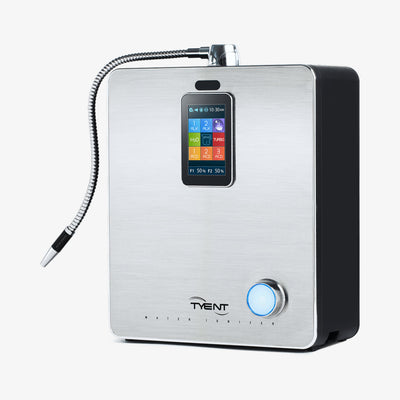 Tyent
Tyent ACE | Countertop Water Ionizer with up to 13 Hybrid Plates
$3,585.00
 Tyent
Tyent ICON Hybrid | Countertop Hydrogen Water Machine
$3,985.00
 Echo Water
Echo H2 | Hydrogen Water Machine with 5-Stage Filter
From $2,399.99
 Tyent
Tyent HALO Hybrid Satin Silver | Under-Sink Hydrogen Water Machine
$4,585.00

